
2026/04/27 NVIDIA, TSMC, and ASML: I Sold Them All. Was I Wrong?

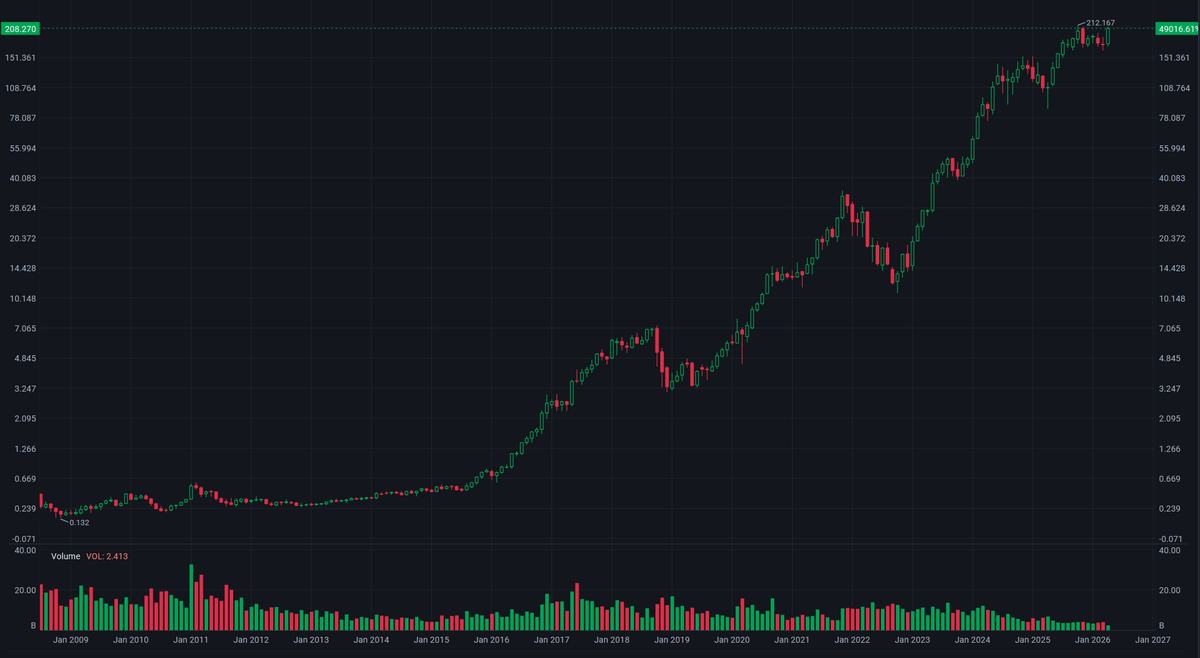
It is now April 27th. Watching the latest stock prices of NVIDIA, TSMC, and ASML surge past my selling points from late January (NVDA $186, TSM $330, ASML $1410), I feel a sharp sting in my nerves.
Was I wrong?
Before January, my mindset was this: these three companies formed the most perfect, invincible "Silicon Trinity" in the history of technology.
- If NVIDIA falls? Any rising AI giant would still need TSMC for foundry services.
- If TSMC falls? Even if Samsung or Intel staged a miraculous comeback, they would still have to queue at ASML’s door for lithography machines.
These three giants hold a world-class, irreplaceable technological monopoly, and their quarterly earnings and forward guidance have been nothing short of exceptional.
Yet, beneath this logic of perfectly hedged business models, a red light was flashing in my mind from last November through January: The risk of AI hardware saturation and the dead-end of current algorithms.
I. Probability Prediction vs. Logical Analysis: The "Intelligence Ceiling" of LLMs
The current prosperity of the AI industry is built on a fragile assumption: that as long as we stack infinite computing power, current Large Language Models (LLMs) will naturally emerge as Artificial General Intelligence (AGI).
But stripping away the hype and the fear-mongering surrounding AGI, the underlying logic of current AI is merely "Next-token prediction based on probability." It simulates intelligence; it does not generate it. To truly reach AGI, AI must cross over into Logical Analysis and Causal Reasoning (System 2 Thinking). Within the existing Transformer architecture and autoregressive algorithms, I do not see the mathematical possibility of bridging this chasm (though I am not a math expert, and I remain open to the emergence of new algorithms).
Unless there is a revolutionary breakthrough in underlying algorithms, we will not enter the era of AGI. If we cannot reach AGI, the industry's focus will shift from "training at all costs" to "patching and engineering optimization" of current probabilistic models.
Hard Data: Diminishing Marginal Returns and the "Money Pit"
The updates from OpenAI’s ChatGPT and Anthropic’s Claude have failed to deliver a "leap in intelligence" that wows me. I keep asking myself: How much has ChatGPT actually progressed compared to three years ago when it first launched? I see a terrifying trend of diminishing marginal utility.
- Exponentially Exploding Training Costs: Training GPT-3 cost in the tens of millions; GPT-4 reached hundreds of millions; for the next generation, single-run training costs are skyrocketing to the billions or even tens of billions.
- The "Compute Devourer": Annual Capital Expenditure (CapEx) for AI infrastructure across Silicon Valley is nearing or exceeding $100 billion. Sequoia Capital proposed the "AI Revenue Gap" theory: for the current massive investment in compute to break even, the AI software sector needs to generate hundreds of billions in annual revenue.
- The Reality: C-end subscription growth is hitting a bottleneck, and B-end enterprise applications remain stuck as "productivity tools" rather than "revolutionary reconstructions." Without a continuous influx of massive funding, these model companies face high risks of bankruptcy and restructuring. Their ultimate fate may be to burn through tens of billions of dollars only to serve as "nutrient soil" for the open-source community (like the Llama ecosystem), contributing to a "proliferation" and total commoditization of large models.
As models converge and open-source explodes, computing power—driven by engineering breakthroughs like quantization, pruning, and ASIC inference chips—will likely become as cheap and ubiquitous as tap water. When that happens, NVIDIA’s staggering 70%+ gross margins will collapse.
II. Physical Limits and the Valuation Trap: The Math of Risk/Reward
Why sell in late January? Because as a trader, I don’t buy a company’s "past"; I buy "odds" and "risk/reward ratios."
At that time, I looked at the market caps of NVIDIA, TSMC, and ASML and asked: what would it take to get a 100% return (a double) in the next three years?
- The Physical Wall: TSMC’s process is approaching 2nm and moving toward 1nm (A10). A silicon atom is roughly 0.2nm in diameter. At the 1nm node, the transistor gate length is only a few atoms wide, where the "Quantum Tunneling Effect" leads to severe power leakage. This means Moore’s Law is hitting a wall both physically and economically. A valuation double in 3–5 years would likely collide head-on with this wall.
- The Terror of Valuation De-rating: If the physical limit arrives within three years, the revenue growth of these three companies will drop from 50%+ hyper-growth to the 15% growth typical of mature tech giants.
- A Zero-Sum Game: The market is pragmatic. When growth expectations decelerate, the Price-to-Earnings (P/E) multiples will be ruthlessly cut in half (e.g., shrinking from 40x to 20x). This means that even if these companies double their profits over the next three years, their stock prices might stay flat due to the valuation compression.
I am well aware that in the final stages of an irrational bubble, market sentiment can push prices up another 50% or even 100% in a short-term spike. But I have no interest in catching the "last leg" of a game of hot potato. When the potential upside no longer matches the physical limits and the business model ceiling, selling is the choice that fits my system. I sold all three because they are all constrained by the fundamental logic that AGI may not arrive.
III. System Discipline and the 10% "Error Clause"
Now, the stock prices have surged past my exit point. Does it sting? Yes. But was I wrong? Within my trading system, I believe I was not. My system requires me to consistently sell assets where the odds and risk/reward no longer meet expectations, and buy those that do.
Based on my conclusion that AGI is not imminent and that current AI is merely a "productivity tool riddled with hallucinations requiring human correction," the crashed software and cybersecurity sectors actually contain significant Alpha for the next 3–5 years. I rotated my capital into vertical software companies whose valuations have hit 10-year lows, specifically because these companies possess "Proprietary Data"—private workflow data that cannot be easily scraped by large models.
Of course, the thought that "I might have sold the three greatest companies of the era" continues to nag at me. As they continue to rise, I admit to a sense of melancholy. I may even face a "double blow"—realizing I traded winners for software companies that might actually be permanently disrupted by AI.
I must constantly test my hypothesis: Am I wrong? AI is indeed the greatest shift in productivity in recent years. By missing it, I might miss significant Alpha. However, my entire thesis rests on one core assumption: "Existing algorithms cannot lead to AGI."
What if I am wrong? What if an AI algorithm breakthrough occurs next month (e.g., the full maturation of a new architecture or a revolutionary non-Transformer disruption) that allows models to master autonomous logical reasoning, bringing us to the brink of AGI?
In my view, there is a 10% probability of this happening.
If that 10% event occurs, the entire Silicon Valley narrative will be rewritten overnight. NVIDIA, TSMC, and ASML would no longer be "pick and shovel" sellers; they would be the infrastructure for a new human civilization. Their risk/reward and odds would change fundamentally.
In that scenario, I wouldn’t need to worry about a "Davis Double Kill" (falling profits and falling valuations) in three years. The win rate and the odds would return, and I would be ready to buy back in at any moment. I do not mind re-entering a position at a price higher than my exit, provided the asset once again fits my system's criteria.
If AGI is truly that 10% miracle, then this 10-year industrial revolution has only just begun. I am in no rush to hold the last baton in the fog. I will continue to observe the evolution of underlying algorithms. The moment the dawn of logical analysis truly appears, I will return to the battlefield with even higher certainty.
27/04/2026 NVIDIA, TSMC et ASML : je les ai vendus. Ai-je eu tort ?
Nous sommes le 27 avril. En regardant mon écran, je vois les cours de NVIDIA, TSMC et ASML dépasser largement mes prix de vente de la fin janvier (NVDA 186 $, TSM 330 $, ASML 1410 $). Mes nerfs sont à vif.
Me suis-je trompé ?
Avant janvier, mon état d'esprit était le suivant : ces trois entreprises constituaient la « Trinité du Silicium » la plus parfaite et la plus invincible de l'histoire technologique.
- NVIDIA chute ? Tout nouveau géant de l'IA aurait toujours besoin de TSMC pour la fonderie.
- TSMC chute ? Même si Samsung ou Intel opéraient un retour miraculeux, ils devraient toujours faire la queue devant la porte d'ASML pour obtenir des machines de lithographie.
Ces trois sociétés détiennent un monopole technologique de classe mondiale, absolument irremplaçable, et leurs résultats ainsi que leurs prévisions (guidance) étaient irréprochables.
Pourtant, sous cette logique commerciale d'une complémentarité parfaite, une alerte clignotait dans mon esprit entre novembre et janvier : le risque de saturation du matériel IA et l'impasse des algorithmes actuels.
I. Prédiction probabiliste vs Analyse logique : le « plafond de verre » des LLM
La prospérité actuelle de l'industrie de l'IA repose sur une hypothèse fragile : il suffirait d'empiler une puissance de calcul infinie pour que les modèles de langage actuels (LLM) fassent émerger une Intelligence Artificielle Générale (AGI).
Mais derrière le marketing spectaculaire de l'AGI, la logique profonde de l'IA actuelle n'est rien d'autre que la « prédiction probabiliste du prochain jeton (Next-token prediction) ». Elle simule l'intelligence, elle ne la génère pas. Pour atteindre la véritable AGI, l'IA doit franchir le cap de l'analyse logique et du raisonnement causal (le « Système 2 »). Or, dans l'architecture actuelle des Transformers et des algorithmes autorégressifs, je ne vois aucune possibilité mathématique de franchir ce gouffre (bien que je ne sois pas mathématicien, et que je reste prêt à l'émergence de nouveaux algorithmes).
Sans une rupture révolutionnaire dans les algorithmes de base, nous n'entrerons pas dans l'ère de l'AGI. Et si nous n'y entrons pas, l'industrie passera d'un entraînement « à tout prix » à une phase d'optimisation technique des modèles probabilistes existants.
Données brutes : rendements marginaux décroissants et gouffre financier
Les mises à jour de ChatGPT (OpenAI) et de Claude (Anthropic) n'ont pas produit le « saut qualitatif » que j'attendais. Je me demande sans cesse : quel est le progrès réel entre ChatGPT aujourd'hui et celui d'il y a trois ans ? Je vois une décroissance terrifiante de l'utilité marginale.
- Explosion exponentielle des coûts : L'entraînement de GPT-3 a coûté des dizaines de millions ; celui de GPT-4 des centaines de millions. Pour la prochaine génération, on parle de milliards, voire de dizaines de milliards de dollars.
- Le « dévoreur de calcul » : Les dépenses d'investissement (CapEx) annuelles dans les infrastructures IA de la Silicon Valley approchent les 100 milliards de dollars. Sequoia Capital a évoqué la théorie du « AI Revenue Gap » : pour rentabiliser ces investissements massifs, le secteur des logiciels IA devrait générer des centaines de milliards de revenus annuels.
- La réalité : Le marché grand public atteint un goulot d'étranglement pour les abonnements, et les applications en entreprise restent des « outils de productivité » et non des « reconstructions révolutionnaires ». Sans un afflux continu de financements massifs, ces entreprises de modèles risquent la faillite. Leur destin final pourrait être de brûler des dizaines de milliards pour finir en « engrais » pour la communauté open source (comme l'écosystème Llama).
Avec la convergence des modèles et l'explosion du libre, la puissance de calcul deviendra aussi banale et bon marché que l'eau courante. À ce moment-là, les marges brutes insolentes de plus de 70 % de NVIDIA s'effondreront.
II. Limites physiques et pièges de valorisation : les mathématiques du risque
Pourquoi avoir vendu fin janvier ? Parce qu'en tant qu'investisseur, je n'achète pas le « passé » d'une entreprise ; j'achète des probabilités et un rapport risque/rendement.
À l'époque, j'ai analysé la capitalisation de NVIDIA, TSMC et ASML : que faudrait-il pour obtenir un rendement de 100 % (doubler la mise) sur trois ans ?
- Le mur de la physique : La gravure de TSMC approche les 2 nm et vise le 1 nm (A10). Un atome de silicium mesure environ 0,2 nm. Au nœud de 1 nm, la grille du transistor ne fait plus que quelques atomes de large, provoquant des effets tunnel quantiques massifs (fuites de courant). La loi de Moore frappe un mur physique et économique. Une valorisation qui doublerait en 3 ou 5 ans se heurterait de plein fouet à ce mur.
- La terreur de la dé-corrélation des multiples : Si la limite physique arrive, la croissance de ces trois entreprises passera de +50 % à environ 15 % (maturité).
- Un jeu à somme nulle : Le marché est pragmatique. Quand la croissance ralentit, le ratio cours/bénéfice (P/E) est impitoyablement divisé par deux (passant par exemple de 40x à 20x). Résultat : même si les bénéfices doublent, le cours de l'action stagne à cause de la compression des multiples.
Je sais que dans la phase finale d'une bulle irrationnelle, l'émotion peut pousser les prix encore 50 % ou 100 % plus haut. Mais je n'ai aucun goût pour le jeu de la « patate chaude ». Quand le potentiel de hausse ne justifie plus le risque face aux limites physiques, vendre est le seul choix cohérent avec mon système.
III. Discipline du système et clause d'erreur de 10 %
Aujourd'hui, les cours ont dépassé mon prix de sortie. Est-ce douloureux ? Oui. Mais ai-je eu tort ? Dans le cadre de mon système de trading, je pense que non. Mon système m'impose de vendre ce qui n'offre plus de rendement espéré suffisant pour acheter ce qui en offre.
Partant du principe que l'AGI n'est pas imminente, j'ai considéré que les secteurs du logiciel et de la cybersécurité, qui s'étaient effondrés, recelaient un Alpha majeur. J'ai réalloué mon capital vers des éditeurs de logiciels verticaux dont les valorisations sont au plus bas depuis 10 ans, car ils possèdent des données propriétaires (Proprietary Data) inaccessibles aux grands modèles.
Bien sûr, l'idée d'avoir vendu les trois entreprises les plus exceptionnelles de l'époque me taraude. Je risque même un « double échec » : voir le matériel continuer de grimper tout en voyant mes logiciels être réellement démantelés par l'IA.
Je dois sans cesse tester mon hypothèse : ai-je tort ? L'IA est le plus grand changement de productivité de ces dernières années. En m'en écartant, je rate peut-être un Alpha historique. Cependant, toute ma thèse repose sur un pilier : « Les algorithmes actuels ne mènent pas à l'AGI. »
Et si je me trompais ? Si une rupture algorithmique (une nouvelle architecture non-Transformer) permettait aux modèles de maîtriser le raisonnement logique le mois prochain ?
À mon sens, il y a une probabilité de 10 % pour que cela arrive.
Si ces 10 % se réalisent, tout le récit de la Silicon Valley sera réécrit. NVIDIA, TSMC et ASML ne seront plus des vendeurs de « pioches et de pelles », mais l'infrastructure même d'une nouvelle civilisation. Le rapport risque/rendement changerait radicalement.
Dans ce scénario, je n'hésiterais pas une seconde à racheter, même à un prix bien plus élevé que mon prix de vente. Je préfère racheter plus haut un actif qui rentre à nouveau dans mes critères de certitude, plutôt que de rester dans l'incertitude aujourd'hui.
Si l'AGI est vraiment ce miracle de 10 %, alors cette révolution industrielle de dix ans ne fait que commencer. Je ne suis pas pressé de tenir le dernier bâton dans le brouillard. Je continuerai d'observer l'évolution des algorithmes. Dès que l'aube de l'analyse logique apparaîtra réellement, je reviendrai sur le champ de bataille avec une certitude renforcée.
2026/04/27英伟达、台积电和ASML:我卖掉了它们,我错了吗?
现在是4月27日。看着屏幕上英伟达、台积电、ASML三家公司的最新股价都越过我1月底的卖出价(NVDA $186,TSM $330,ASML $1410),我的神经被刺痛了。
我错了吗?
1月份之前我的心态:当时的这三家公司,构成了人类科技史上最完美、最坚不可摧的“硅基三位一体”护城河:
- 英伟达倒了? 只要有新的AI巨头崛起,依然要找台积电代工。
- 台积电倒了? 哪怕三星或Intel奇迹般翻盘,它们依然得在ASML门前排队买光刻机。 这三家公司掌握了世界一流、完全不可替代的技术垄断权,且每一期的财报业绩和Forward Guidance(前瞻指引)都非常不错。
但在完美的互相支撑对冲的业务逻辑下,从去年的11月份到1月份我的大脑却在疯狂闪烁着红灯:AI硬件的饱和风险与底层算法的穷途末路。
一、 概率预测 vs. 逻辑分析:大模型的“智力天花板”
当前整个AI产业的繁荣,建立在一个脆弱的假设上:只要算力无限堆叠,现在的LLM(大语言模型)就能涌现出AGI(通用人工智能)。
但剥开所有华丽和恐惧的AGI宣传,当前AI的底层逻辑仅仅是**“基于概率的下一个Token预测(Next-token prediction)”**。它在模拟智能,而不是产生智能。如果我们要真正触及AGI,AI必须跨越到“逻辑分析与因果推理(System 2 Thinking)”。而在现有的Transformer架构和自回归算法中,我看不到跨越这道鸿沟的数学可能性(当然我不是数学专家,我随时也要准备新算法的出现)。
除非底层算法发生革命性突破,否则我们无法进入AGI时代。而如果无法进入AGI,接下来的行业主轴将从“不计代价的疯狂训练”变成“当前概率预测算法的修补与工程优化”。
硬核数据支撑:边际效用递减与烧钱无底洞 OpenAI的ChatGPT和Anthropic的Claude的更新并没有带来让我惊艳的“智力跃升”,我不断问自己:现在ChatGPT和Claude等大模型,和3年前ChatGPT刚推出的时候究竟有多大进步?我看到了恐怖的边际效用递减。
- 训练成本呈指数级爆炸: 训练GPT-3耗资千万美元级别;GPT-4达到了上亿美元;而到了新一代模型,单次训练成本直接飙升至10亿至数十亿美元。
- 算力支出的“吞金兽”: 整个硅谷在AI基础设施上的年化资本支出(CapEx)已经逼近甚至超过千亿美元。风投红杉资本(Sequoia)曾提出过一个“AI营收缺口(The AI Revenue Gap)”理论:为了让现有的高昂算力投资回本,AI软件端需要每年创造数千亿美元的净收入。
- 现实是: C端订阅瓶颈已现,B端企业应用仍停留在“提效工具”而非“革命性重构”。在没有新一轮天量融资续命的情况下,这些大模型公司面临极高的破产重组风险。他们最终的命运,可能是耗尽数百亿美元,悲壮地化作开源社区(如Llama生态)的养料,促成大模型的“百花齐放”与彻底廉价化。
当模型趋同、开源爆发,算力很可能会在工程突破(如量化、剪枝、推理芯片ASIC化)下,变得像自来水一样便宜。 届时,英伟达那高达70%+的变态毛利率将轰然崩塌。
二、 物理极限与估值陷阱:盈亏比的数学题
为什么在1月底卖出?因为作为交易者,我不买公司的“过去”,我买的是“赔率”和“盈亏比”。
当时我是这样子想的:看看英伟达、台积电、ASML在1月价位下的市值规模,假设要在未来3年内获得100%的回报(翻1倍):
- 物理学定律的终极碾压: 台积电目前的制程已经逼近2纳米,并向1纳米(A10)迈进。硅原子的直径大约是0.2纳米。到了1纳米节点,晶体管的栅极长度只有几个原子的宽度,“量子隧穿效应(Quantum Tunneling)”将导致严重的漏电。这意味着摩尔定律在物理和经济学上即将同时撞墙。那么3-5年市值翻一倍后,大概率遇到这种撞墙。
- “杀估值”的恐怖威力: 假设3年内物理极限到来,这3家公司的营收增速从动辄50%+的高速增长期,回落到传统科技巨头15%的成熟期增速。
- 零和博弈: 市场是极其现实的。当增速放缓预期兑现,市场给它们的市盈率(P/E)估值倍数将无情地砍掉一半(例如从40倍缩水到20倍)。这就意味着,即便这三家公司在未来3年内利润依然保持增长,甚至净利润翻倍,但由于估值乘数被腰斩,其股价很可能在3年后依然原地踏步。
我当然知道,在非理性的泡沫末期,市场情绪可以将股价再推高50%甚至短期内爆冲100%。但我从来不喜欢去接“击鼓传花”的最后一棒。当标的的潜在上涨空间与其面临的物理极限、商业模式天花板不再匹配,当盈亏比不再能给我的交易系统带来Alpha时,卖出就是符合系统的选择。 于是,我把这三个公司都卖掉了,因为它们都受制于AGI无法到来的根本逻辑。
三、 系统的纪律与 10% 的“认错条款”
现在,股价涨过了我的卖出价。我刺痛吗?刺痛。但我错了吗?在我的交易系统内,我应该是没有错的。因为我的系统要求我要不断卖出赔率和盈亏比不符合期望的,而买入赔率和盈亏比符合期望的。当我形成了AGI无法到来的结论,现在的AI只是“带着幻觉需要真人矫正的生产力提高工具”,暴跌的软件和网络安全板块反而在我看来蕴含了未来3-5年的重大alpha。我转而买入了一些估值跌到近10年新低的垂直领域的软件公司,是因为这些公司拥有“不可被大模型轻易抓取的私域工作流数据(Proprietary Data)” .
当然,这种“可能卖掉了当下时代最伟大的3个公司”的想法在不断刺痛着我。当它们不断上涨,我承认我有一种惆怅感。我未来可能还要面对“可能换成了永久被AI颠覆的软件公司”的双重打击。
我必须不断检验,我错了吗?因为AI确实是最近几年发生的最大生产力变化。错过它,我可能错过了很多ALPHA.我的上述所有推论,都建立在一个核心假设上——“现有算法无法通向AGI”。
如果我是错的呢? 如果AI算法在下个月突然出现突破(例如新架构的完全成熟,或者非Transformer架构的革命性颠覆),让模型真正掌握了自主逻辑推理,无限逼近了AGI呢?
在我看来,这种可能性大约是 10%。
如果这 10% 的概率事件发生,那么整个硅谷的叙事将瞬间重写。 届时,英伟达、台积电、ASML就不再是“卖铲子”的公司,而是构建人类新文明的基础设施,它们的盈亏比和赔率将发生质的改变。
到那个时候,就不用担心股价会在3年后戴维斯双杀原地踏步,而是胜率和赔率都回来了,我随时准备将它们买回来。我一点也不介意在一个比我卖出价更高的位置,重新建仓一个再次符合我系统期望值的好标的。
如果 AGI 真的是那 10% 的神迹,那么这场长达 10 年的工业革命才刚刚拉开序幕。我不必急于在迷雾中守住最后一棒。我会持续观测底层算法的演进,一旦逻辑分析的曙光真正出现,我会带着更高的确定性杀回战场。
Risk Warning: This post is a result of personal study and does not constitute financial advice. I am currently in the process of learning translation, so there may be inaccuracies in the language used.
Position Disclosure: As of the time of publication, the author holds no position in this company. This article was written solely out of research interest. The author has no plans to initiate any positions within the next 72 hours.