
2026/04/28 Hamilton Lane (HLNE): Can the "Pioneer" of Private Market Democratization Sustain Its High Growth?

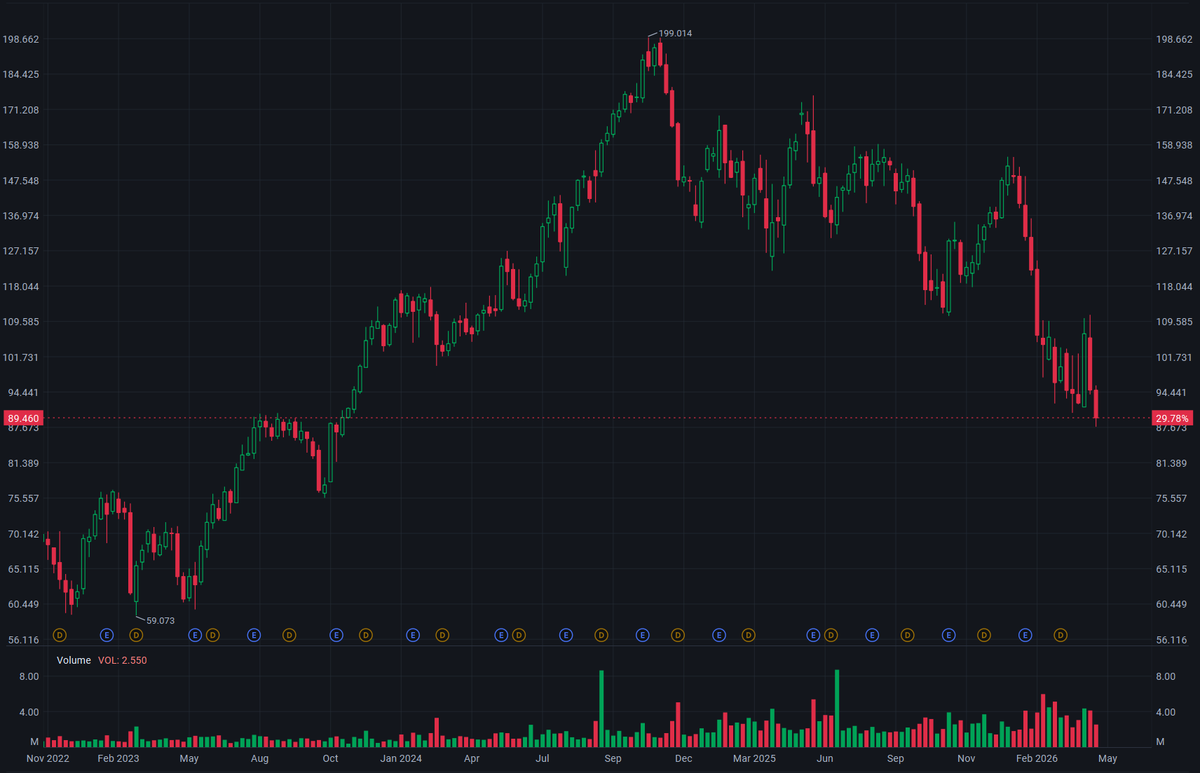
Hamilton Lane is a leading global private markets investment manager. Its hallmark lies in its powerful Cobalt data analytics platform and industry-leading Evergreen Funds. It transforms opaque private investments—traditionally reserved for top-tier institutions—into high-liquidity, data-driven financial products accessible to individual investors.
- Performance: In Q3 FY2026, EPS reached $1.55 (beating expectations by 21%), with management fee revenue growing by 31%. While the data is stellar, short-seller reports allege these results are the product of "accounting magic."
- Price-to-Earnings (P/E): The ratio has dropped to 16x – 17x, sitting at a five-year historical bottom. If the allegations are a misunderstanding, this is an opportunity; if true, it is a "valuation trap."
The Industry Gap and the "Bridge"
Private assets currently account for less than 2% of the asset allocation for global retail and high-net-worth (HNW) individuals, compared to over 20% for institutional investors. This gap is massive. HLNE has already built mature "bridges" like its Evergreen Funds to facilitate individual participation. Since the industry tailwinds are undeniable, the focus must shift to evaluating Hamilton Lane as a company.
The Controversy: Accounting and the "Day One Markup"
In the secondary market, buyers (like HLNE) often purchase assets worth $100 for $80 or $90 from liquidity-strapped sellers.
- GAAP Rules: Under U.S. GAAP, you can record these at "Fair Value." If the market agrees the asset is worth $100, a $80 purchase can be immediately recorded as $100 on the books.
- The Conflict: Traditional private equity only takes a "carry" (performance fee) once the asset is sold and cash is returned. However, HLNE has modified this model. As soon as it marks up the book value of a purchased asset (the $20 paper gain mentioned above), it draws a portion as Incentive Fees, even before the asset is sold.
Short-Seller Allegations (Hunterbrook Capital)
- Valuation Driver: This "Day One Markup" reportedly contributed to approximately 1/3 of HLNE’s valuation growth. Without this tactic and the new fee structure, its Fee-Related Earnings (FRE) would have allegedly dropped by 16% in 2025, rather than the reported 37% growth.
- Rule Changes: In March 2025, HLNE persuaded shareholders to remove the 8% preferred return hurdle. This means the firm no longer needs to earn an 8% return for investors before it starts taking its cut.
- Outflows and Incentives: By March 2026, HLNE saw $172 million in outflows—the largest in its history. The report notes that the timing of these rule changes aligned with massive equity awards for the co-CEOs (approx. $71 million each).
Revenue Structure Breakdown: How much is at risk?
Based on FY2026 data:
- Management Fees (~73%): "Hard money" based on AUM. This is stable and represents the company’s moat.
- Realized Performance Fees (~10%): Actual cash distributed after asset sales.
Unrealized Performance Fees (Contested) (~15%–17%):
This disputed amount accounts for roughly 1/5 of total revenue. While not the majority, long-term trust is the absolute prerequisite for growth in the asset management industry.
Peer Comparison: Does everyone do this?
- Traditional PE (e.g., KKR, Carlyle): Generally adhere to the "Cash Return Principle." Paper gains of 10x mean nothing until the company is sold and cash is returned to investors.
- Blackstone Retail Products: They also charge incentive fees on unrealized gains, but they typically maintain strict Hurdle Rates (usually 5% – 7%).
- The Difference: HLNE is accused of lowering or removing this hurdle. This implies HLNE can collect performance fees via "Day One Markups" even with mediocre performance, whereas Blackstone must first ensure the client has earned their share.
The Essence of Finance: Reputation as the Bedrock
Asset management is a "reputation business." A firm's core asset is not its office buildings, but the "fiduciary mandate" from its clients.
- Principal Erosion: Retail investors may not grasp complex GAAP rules, but they are hyper-sensitive to "account balances." Taking fees on unrealized gains essentially erodes the compounding growth of the client’s principal. The psychological barrier of "they took my money before I even made a profit" is significant.
- Churn Risk: Private assets usually have high "stickiness," but this dissolves if retail investors feel their capital is shrinking while management takes record pay. The $172 million net outflow in March 2026 suggests capital is seeking more "refined" alternatives.
Management’s Response
Currently, management’s response remains at the legal and compliance level: emphasizing that all operations comply with GAAP and claiming short-sellers misunderstand the "nuances" of private markets. While they are aggressively promoting AI and infrastructure outlooks, there is no sign of adjusting the fee structure to be more investor-friendly (e.g., reinstating the hurdle rate).
Investment Watchpoints
The decision to invest in HLNE shouldn't be based on the attractive 17x P/E, but on how management handles this crisis of confidence.
Three signals to watch:
- Annual Report Meeting (May 21): Will management directly breakdown the performance fee composition or dodge the issue?
- Net Outflow Data: Will redemption volumes continue to expand in April and May?
- Regulatory Stance: Will the SEC issue inquiries regarding the removal of the preferred return hurdle?
Final Thought: If the Cobalt platform itself is biased toward "Day One Markups" in its underlying data, does its "power" actually become a tool for window-dressing?
Until the credibility dispute is resolved, HLNE remains on the watch list. In asset management, confidence and client psychology trump balance sheet figures. When growth is driven by "modifying accounting rules" at the expense of client interests, that growth is fragile. However, because the gap between retail (2%) and institutional (20%) private asset allocation is so vast, this niche remains highly attractive. I should monitor other firms in this space; if HLNE eventually restores client trust, it could once again become a prime target.
28/04/2026 Hamilton Lane (HLNE) : La forte croissance du "pionnier" de la démocratisation du non-coté peut-elle durer ?
Hamilton Lane est un expert mondial de premier plan dans la gestion d'actifs sur les marchés privés. Sa particularité réside dans sa puissante plateforme d'analyse de données Cobalt et ses fonds "Evergreen" (fonds ouverts) leaders du secteur. L'entreprise transforme des investissements privés opaques, autrefois réservés aux grandes institutions, en produits financiers liquides, pilotés par la donnée et accessibles aux investisseurs particuliers.
- Performance : Au T3 de l'exercice fiscal 2026, l'augmentation du bénéfice par action (BPA) a atteint 1,55 $ (dépassant les prévisions de 21 %), avec une croissance des commissions de gestion de 31 %. Si les chiffres sont éclatants, des rapports de vente à découvert soupçonnent ces résultats d'être le fruit d'une "magie comptable".
- Ratio Cours/Bénéfice (P/E) : Tombé à 16x - 17x, soit au plancher historique des cinq dernières années. Si les accusations sont infondées, c'est une opportunité ; si elles sont vraies, c'est un "piège à valorisation".
Le fossé industriel et le rôle de "Pont"
Dans l'allocation d'actifs des particuliers et des clients fortunés (HNW) au niveau mondial, les actifs privés représentent moins de 2 %, contre plus de 20 % pour les investisseurs institutionnels. Ce fossé est colossal. HLNE a déjà mis en place des "ponts" matures comme les fonds Evergreen pour faciliter la participation des particuliers. Le secteur étant porteur, il convient d'évaluer précisément la qualité de l'entreprise Hamilton Lane.
La controverse : Comptabilité et "Réévaluation au premier jour"
Sur le marché secondaire du non-coté, les acheteurs (comme HLNE) achètent souvent des actifs valant 100 $pour 80$ ou 90 $ auprès de vendeurs pressés de liquidités.
- Normes GAAP : Selon les principes comptables américains, il est possible d'enregistrer ces actifs à leur "juste valeur". Si le marché estime que l'actif vaut 100 $, un achat à 80 $peut être inscrit immédiatement au bilan pour 100$.
- Le conflit : Le capital-investissement traditionnel ne prélève des commissions de performance (carried interest) que lorsque l'actif est vendu et que l'argent est réellement encaissé. HLNE a modifié ce modèle : dès qu'elle réévalue à la hausse la valeur comptable d'un actif acheté (la plus-value latente de 20 $ mentionnée plus haut), elle en prélève une partie au titre des commissions de performance, même si l'actif n'a pas encore été vendu.
Rapport du vendeur à découvert (Hunterbrook Capital)
- Levier de valorisation : Cette "réévaluation au premier jour" aurait contribué à environ 1/3 de la croissance de la valorisation de HLNE. Sans cette méthode et ce nouveau modèle de frais, son bénéfice lié aux commissions (FRE) aurait dû baisser de 16 % en 2025, au lieu de la croissance de 37 % affichée.
- Modification des règles : En mars 2025, HLNE a convaincu ses actionnaires de supprimer le seuil de rendement prioritaire de 8 % (hurdle rate). Cela signifie qu'elle n'a plus besoin de faire gagner 8 % à ses investisseurs avant de commencer à prélever sa part.
- Sorties de capitaux : En mars 2026, HLNE a enregistré des sorties nettes de 172 millions $, un record historique. Le rapport souligne que le moment choisi pour changer ces règles correspond précisément à l'attribution de stock-options massives aux deux co-PDG (environ 71 millions $ chacun).
Décomposition du chiffre d'affaires : Quelle part est contestée ?
Selon les données de l'exercice 2026 :
- Commissions de gestion (~73 %) : Revenus récurrents basés sur les actifs sous gestion (AUM). C'est la partie solide, le "fossé" de l'entreprise.
- Commissions de performance réalisées (~10 %) : Argent réel perçu après la vente des actifs.
Commissions de performance non réalisées (part contestée) (~15-17 %) :
Le montant contesté représente environ 1/5 du chiffre d'affaires total. Bien que ce ne soit pas la majorité, la confiance à long terme est la condition absolue de la croissance dans la gestion d'actifs.
Comparaison avec les pairs : Est-ce une pratique courante ?
- Acteurs traditionnels (ex: KKR, Carlyle) : Ils maintiennent le principe du "retour sur cash". Une plus-value latente de 10x sur le papier ne compte pas ; il faut attendre la vente de l'entreprise pour toucher sa part.
- Produits de détail de Blackstone : Ils prélèvent également des commissions sur les gains non réalisés, mais maintiennent généralement un Hurdle Rate strict (souvent entre 5 % et 7 %).
- Le point de divergence : On reproche à HLNE d'avoir abaissé, voire supprimé ce seuil en 2025. Cela signifie que même avec une performance médiocre, HLNE peut capter des profits via des réévaluations comptables, là où Blackstone doit d'abord s'assurer que ses clients ont gagné suffisamment d'argent.
L'essence de la finance : La réputation comme fondement
La gestion d'actifs est une activité de "confiance". L'actif principal n'est pas le parc immobilier, mais le mandat de gestion confié par le client.
- Érosion du capital : Les investisseurs particuliers ne comprennent peut-être pas les subtilités des normes GAAP, mais ils sont extrêmement sensibles au "solde de leur compte". Si HLNE prélève par avance des bénéfices non réalisés, elle érode la croissance composée du capital des clients.
- Perte d'adhérence : Les actifs privés ont généralement une forte rétention, mais si les clients sentent que leur capital fond pendant que la direction s'octroie des salaires records, cette fidélité s'effondrera. Les sorties records de mars 2026 suggèrent que les capitaux cherchent déjà des alternatives plus "élégantes".
Points de vigilance pour l'investissement
La décision d'investir dans HLNE ne dépend pas de l'attractivité du P/E actuel de 17x, mais de la manière dont la direction gérera cette crise de confiance.
Trois signaux à surveiller :
- Conférence annuelle du 21 mai : La direction osera-t-elle détailler la composition des commissions de performance de manière transparente ?
- Données de sorties nettes : L'ampleur des rachats va-t-elle s'accentuer en avril et mai ?
- Position des régulateurs : Est-ce que la SEC lancera une enquête sur la suppression du seuil de rendement prioritaire ?
En conclusion : Tant que le litige sur la crédibilité n'est pas résolu, HLNE reste un titre sous observation. Dans ce secteur, la confiance et la psychologie des clients priment sur les chiffres comptables. Si la croissance d'une entreprise est principalement tirée par la "modification des règles comptables" au détriment des clients, elle est fragile. Néanmoins, le potentiel du segment "retail" dans le non-coté reste immense, et il conviendra de surveiller les concurrents qui pourraient capter ces flux si HLNE ne parvient pas à restaurer sa réputation.
2026/04/28 Hamilton Lane :私募零售化“先驱”的高增长能否持续?
Hamilton Lane 是一家全球领先的私募市场资产管理专家,其特色在于通过强大的 Cobalt 数据分析平台和行业领先的零售化常青基金(Evergreen Funds),将原本属于顶级机构的不透明私募投资,转化为高流动性、数据驱动且易于个人投资者参与的金融产品。
- 业绩: 2026 财年 Q3 EPS 为 $1.55(超预期 21%),管理费收入增长 31%。数据上看极其亮眼,但有做空报告怀疑这是会计魔术的结果。
- 市盈率 (P/E): 降至 16x - 17x,处于过去五年的历史底部。如果指控是误读,这是机会;如果指控属实,则是“估值陷阱”。
全球散户和高净值人群的资产配置中,私募资产占比不到 2%,而机构投资者高达 20% 以上。这个缺口是巨大的。HLNE 已经搭建好了像 Evergreen 这样成熟的“桥梁”,易于个人投资者参与。既然行业没问题,那么就需要仔细评估Hamilton Lane这家公司如何。
在私募二级市场,买家(如 HLNE)经常能以 8 折、9 折的价格从急需用钱的卖家手中买到原本值 100 块的资产。 根据美国通用会计准则(GAAP),你可以按照“公允价值”记账。如果市场普遍认为这资产值 100 块,你 80 块买进来,当天就可以在账面上记为 100 块。 传统的私募是“卖了资产见到真钱”才分提成。但 HLNE 修改了模式,只要它把买回来的资产在账面上调高了(即上述的 20 块浮盈),即便资产还没卖出去,它也要从中抽走一部分作为业绩报酬(Incentive Fees)。
做空机构 Hunterbrook Capital 报告称,这种“首日调高”贡献了 HLNE 约 1/3 的估值增长。如果没有这一招和新的收费模式,它的费率相关利润(FRE)在 2025 年原本应该是下降 16%,结果报表上却是增长 37%。2025 年 3 月,HLNE 说服股东取消了 8% 的优先回报门槛。这意味着它不需要先帮投资者赚够 8%,就可以开始分钱。 2026 年 3 月HLNE已经出现了 1.72 亿美元 的史上最大流出。报告特别提到,改规矩收钱的时间点正好对应了两位联席 CEO 获得巨额股权奖励的时间(每人约 7100 万美元)。
营收结构拆解:被质疑的部分有多少?
根据 2026 财年数据:
- 基础管理费 (Management Fees) —— 约 73%: 这部分是基于资产规模(AUM)收取的“硬钱”,基本无水分,是公司的护城河。
- 已实现业绩费 —— 约 10%: 资产卖出后分到的钱,是实打实的现金。
- 未实现业绩费 (受质疑部分) —— 约 15%-17%: > 争议金额约占总营收的 1/5。虽然不是大头,但资产管理行业,长期信任是支撑增长的绝对条件。
同行处理方式:别人是否也这样做?
传统的私募(如 KKR, Carlyle): 依然坚持 “现金回归原则”。即:我账面上帮你赚了 10 倍没用,必须等我把公司卖了,钱回到投资者口袋里,我才拿走我那份。
黑石 (Blackstone) 的零售产品: 也会对“未实现利润”收业绩报酬,但他们通常设有严格的 Hurdle Rate(门槛收益率,通常为 5% - 7%)。
- 区别点: HLNE 在 2025 年被指责降低甚至取消了这一门槛。这意味着即便表现平平,HLNE 也能通过会计上的“首日调高”直接提走业绩报酬,而黑石则必须确保帮客户赚够了钱才能动这块蛋糕。
金融本质:信誉是长粘性的根基
资管行业是“替人理财”,本质是信誉生意。资管公司的核心资产不是那一两栋大楼,而是客户的“授权委托意愿”。 信任才是根基。
- 本金侵蚀: 散户投资者可能不懂复杂的会计准则,但他们对“账户余额”极度敏感。如果 HLNE 提前抽走未实现的利润,本质上是在侵蚀客户本金的复利增长。这种“还没赚钱就比别人多收了我的钱”的心理会是散户继续在该公司的重大心理阻力。
- 粘性流失: 私募资产通常有长粘性,但一旦散户发现自己的钱在缩水,而管理层在拿高薪,这种粘性会崩解。2026 年 3 月 1.72 亿美元 的净流出(史上最大规模)似乎暗示,资金正在寻找更“文雅”的去处。
管理层的应对
目前管理层的回应主要集中在法律和准则层面:强调所有操作符合 GAAP 会计准则,认为做空者不懂私募市场的“细微差别”。密集发布 AI 和基础设施的投资展望,尚未看到管理层主动提出对收费模式进行更利于投资者的调整(如恢复门槛收益率)。
投资观察点:决定胜负的关键点
决定要不要投资 HLNE,不是看现在的 17 倍 P/E 有多诱人,而是看管理层如何管理这场信任危机。
以下三个信号需要我去观察:
- 5 月 21 日年报会议: 管理层是否敢于正面拆解业绩费构成,而非避重就轻。
- 净流出数据: 4 月和 5 月的赎回规模是否继续扩大。
- 监管姿态: SEC 是否会针对其“取消优先回报门槛”的行为发起询问。
还有:Cobalt 平台的风险点:如果底层数据录入本身就存在“首日调高”的偏见,那么这个数据平台的“强大”是否反而成了美化报表的工具?
在信誉争议未解决前,HLNE 属于观察标的。资产管理行业,信心和客户心理优于报表数字考虑。当一家公司的盈利增长主要靠“修改会计规则”和“牺牲客户利益”来驱动时,它的高成长是脆弱的。 既然全球散户和高净值人群的资产配置中,私募资产占比不到 2%和机构投资者高达 20% 以上存在着巨大缺口,即便 HLNE 出问题,这个缺口本身依然极具潜力。我应该多注意这个细分领域的资产管理公司的表现。如果HLNE之后重塑了客户信心,那么HLNE本身就是一个很好的标的。
Risk Warning: This post is a result of personal study and does not constitute financial advice. I am currently in the process of learning translation, so there may be inaccuracies in the language used.
Position Disclosure: As of the time of publication, the author holds no position in this company. This article was written solely out of research interest. The author has no plans to initiate any positions within the next 72 hours.