
2026/04/06 The "ARM of the Display World" at 18x PE: Is Universal Display (OLED) Undervalued?

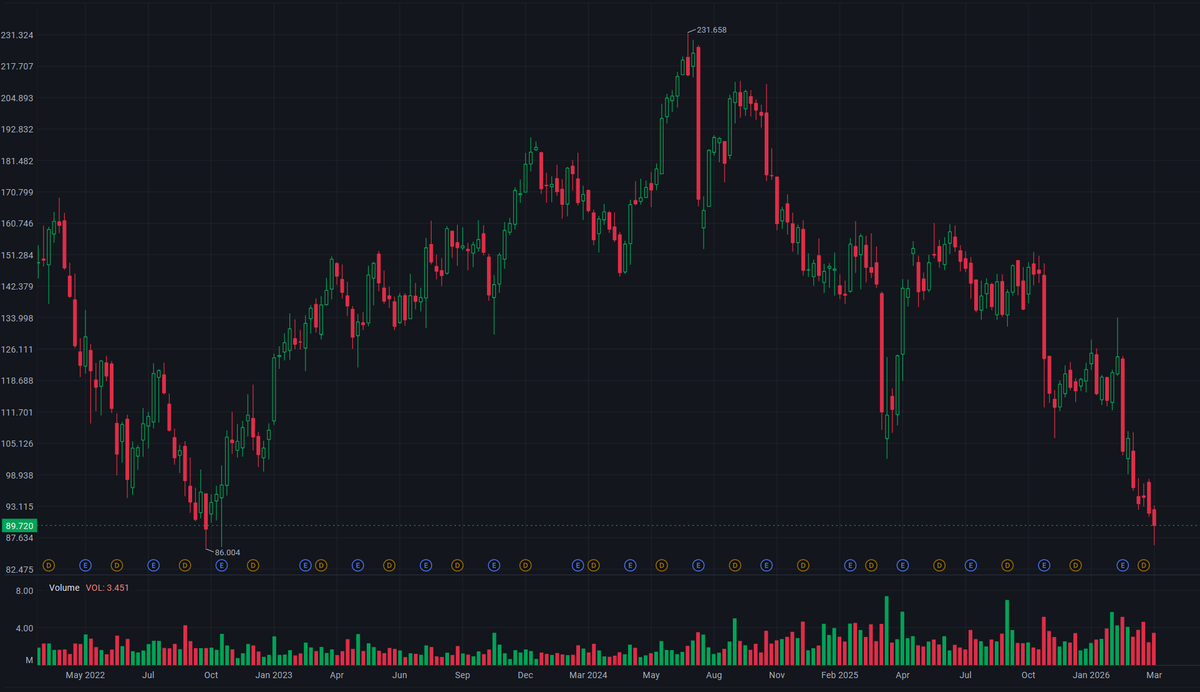
A tech company with gross margins exceeding 70% and a patent monopoly—Universal Display (OLED)—is currently being valued by the market as a manufacturing firm. To me, this signals a strong margin of safety. At the same time, I see potential explosive power over the next 3 to 5 years driven by a technological wave. This creates the favorable conditions for a "Davis Double," which sparked my research interest. A second evolution, triggered by a doubling of screen surface area and core material iteration, is pushing this company with its deep moat to the eve of a new breakout point.
I. Business Model: The Deepest "Moat" in the Tech Industry
The core of OLED's business can be summarized as: Patent Monopoly + Asset-Light + High Gross Margin. Universal Display’s gross margin stands at a staggering 76%. This is not typical of the manufacturing sector; rather, it reflects the level of top-tier software or patent licensing firms.
- Rent-Seeking, Not Plant-Building: Holding over 6,000 PHOLED patents, the company ensures that whether it is Samsung, LG, or BOE, anyone producing high-efficiency OLED screens must pay licensing fees and purchase their exclusive materials.
- An ARM-like Architecture: It defines the efficiency standards for OLED light emission. Just as mobile phones cannot function without the ARM instruction set, high-performance OLEDs cannot exist without Universal Display’s phosphorescent materials.
II. Core Driver: The Leap from "Square Centimeters" to "Square Meters"
In the 3-to-5-year cycle ahead, Universal Display’s growth logic is shifting from "smartphone penetration" to "Large Screens for All Scenarios":
- The IT Explosion (The Apple Effect): The transition of the Apple iPad Pro to OLED is just the prelude. With the popularization of Tandem (two-stack) technology, the material consumption of a single device (like a future MacBook) will be 6 to 8 times that of a smartphone. This means that even if device sales remain flat, material revenue will achieve non-linear growth due to the "area multiplier" and "stacking layers." The 8.6-generation OLED production lines currently being built by Samsung and BOE at great expense are specifically designed to meet this wave of IT device replacement.
- The "Incremental Heaven" of Automotive Displays: The pursuit of battery range and aesthetic interior design in electric vehicles has made OLED a standard feature for mid-to-high-end models. Automotive screens have long validation cycles and stable lifecycles; once entered, the supply chain provides Universal Display with extremely stable, high-margin cash flow for the next 5 to 10 years.
III. Breakout Point: The Final Puzzle Piece of Blue PHOLED
In current OLED screens, red and green have already achieved high-efficiency phosphorescence, while blue still uses lower-efficiency fluorescent materials.
- Technological Dividend: OLED is expected to achieve the commercialization of blue phosphorescent materials between 2026 and 2027. This could reduce total device power consumption by more than 25% and, more importantly, signifies that Universal Display will complete its final technological map, significantly increasing the patent value premium per panel.
- Time Window: 2026 is the critical year for technical validation, while 2027–2028 will be the breakout years for earnings realization.
IV. Valuation Analysis: Is a $4.3 Billion Market Cap Expensive?
As of April 2026, Universal Display’s Price-to-Earnings (P/E) ratio is approximately 18x, sitting at a ten-year historical low. Using probabilistic thinking, I conducted a stress test on return expectations for the next 3 to 5 years:
- Explosive Growth Scenario (65% Probability): If Blue PHOLED lands as scheduled and the Apple IT lines and automotive markets reach full volume, Universal Display will see a "Davis Double" in both revenue and valuation. If Earnings Per Share (EPS) grows from the current $5.08 to over $8.50, and the market returns to its historical mean P/E of 30x, the market cap could reach $11 billion to $13 billion, representing a potential upside of approximately 180%.
- Steady Growth Scenario (25% Probability): If the new material progresses steadily but without surprises, the company will still grow with the natural industry dividend of large-screen adoption. Maintaining the current 18x valuation, the market cap is expected to grow steadily to $5.5 billion – $6.5 billion, providing a relatively certain return of 30%–50%.
- Growth Obstacle Scenario (10% Probability): This is the baseline for risk prevention. If the company faces pricing pressure from domestic substitution or severe setbacks in Blue PHOLED R&D, the market might re-rate it as a traditional chemical stock, with the P/E dropping to 12x. Under this extreme stress test, the market cap floor is around $3 billion to $3.5 billion, representing a maximum drawdown of about 30% from current levels.
V. Conclusion: My Logic
Universal Display is currently at the intersection of a "technological breakout eve" and a "rational valuation trough."
Disruptive risks (such as Micro-LED) are unlikely to achieve the scale and cost advantages required for the mass market within the next 3 to 5 years. Therefore, at a $4.3 billion market cap, I personally estimate the odds (ratio of potential upside to downside) to be roughly 6:1. Investing in Universal Display now is akin to buying a "monopoly ticket" to the top tier of the future display industry at a "common manufacturing" price (P/E ~18x). Over the next 1 to 3 years, I will gradually verify whether my hypothesis is correct.
6 avril 2024 L'« ARM du monde de l'affichage » à 18x P/E : Universal Display (OLED) est-elle gravement sous-estimée ?
Une entreprise technologique avec une marge brute supérieure à 70 % et un monopole sur les brevets — Universal Display (OLED) — se voit actuellement attribuer par le marché une valorisation digne du secteur manufacturier. Pour moi, c'est un signal fort de marge de sécurité. Parallèlement, je perçois un potentiel d'explosion pour les 3 à 5 prochaines années, porté par une vague technologique. Cela réunit les conditions favorables à un « double de Davis », ce qui a suscité mon intérêt pour cette recherche. Une seconde évolution, déclenchée par le doublement de la surface des écrans et l'itération des matériaux de base, pousse cette entreprise dotée d'un fossé protecteur (« moat ») profond à la veille d'un nouveau point de rupture.
I. Modèle économique : Le « fossé » le plus profond du secteur technologique
Le cœur de métier d'OLED peut se résumer ainsi : Monopole des brevets + Allégement des actifs + Marge brute élevée. La marge brute d'Universal Display s'élève à 76 %, ce qui ne correspond pas du tout aux standards de l'industrie manufacturière, mais plutôt à ceux des meilleures entreprises de logiciels ou de licences de brevets.
- Rentier plutôt qu'industriel : Détentrice de plus de 6 000 brevets PHOLED, l'entreprise impose à tout producteur d'écrans OLED haute efficacité — qu'il s'agisse de Samsung, LG ou BOE — de payer des redevances et d'acheter ses matériaux exclusifs.
- Une architecture de type ARM : Elle définit les standards d'efficacité lumineuse de l'OLED. Tout comme un smartphone ne peut se passer du jeu d'instructions ARM, un écran OLED haute performance ne peut se passer des matériaux phosphorescents d'Universal Display.
II. Moteur principal : Le bond du « centimètre carré » au « mètre carré »
Sur un cycle de 3 à 5 ans, la logique de croissance d'Universal Display passe de la « pénétration des smartphones » à « l'omniprésence des grands écrans » :
- L'explosion de l'informatique (l'effet Apple) : Le passage de l'iPad Pro à l'OLED n'est qu'un prélude. Avec la généralisation de la technologie Tandem (double couche), la consommation de matériaux d'un seul appareil (comme un futur MacBook) sera 6 à 8 fois supérieure à celle d'un téléphone. Cela signifie que même si les volumes de vente restent stables, les revenus liés aux matériaux connaîtront une croissance non linéaire grâce au « multiplicateur de surface » et à l'empilement des couches. Les lignes de production OLED de génération 8.6, dans lesquelles Samsung et BOE investissent massivement, sont précisément destinées à cette vague de renouvellement informatique.
- Le « paradis de croissance » de l'affichage automobile : La quête d'autonomie et d'esthétique intérieure des véhicules électriques fait de l'OLED un équipement standard pour les modèles moyen et haut de gamme. Les cycles de validation automobile sont longs et les cycles de vie stables ; une fois intégrée à la chaîne d'approvisionnement, celle-ci garantira à Universal Display des flux de trésorerie à haute marge extrêmement stables pour les 5 à 10 prochaines années.
III. Point d'explosion : Le puzzle final du PHOLED Bleu
Actuellement, dans les écrans OLED, le rouge et le vert sont déjà passés à la phosphorescence haute efficacité, tandis que le bleu utilise toujours des matériaux fluorescents moins performants.
- Dividende technologique : La commercialisation des matériaux phosphorescents bleus est prévue pour 2026-2027. Cela permettra de réduire la consommation d'énergie des appareils de plus de 25 %, et signifie surtout qu'Universal Display complétera sa cartographie technologique, augmentant ainsi significativement la prime de valeur des brevets par panneau.
- Fenêtre temporelle : 2026 sera l'année charnière pour la validation technique, tandis que 2027-2028 seront les années d'explosion des résultats financiers.
IV. Analyse de la valorisation : Une capitalisation de 4,3 milliards $ est-elle chère ?
À la date d'avril 2026, le ratio cours/bénéfice (P/E) d'Universal Display est d'environ 18x, soit un plus bas historique sur dix ans. En utilisant une approche probabiliste, j'ai effectué un test de résistance sur les prévisions de rendement à 3-5 ans :
- Scénario de croissance explosive (probabilité 65 %) : Si le PHOLED bleu se concrétise comme prévu et que les marchés de l'informatique Apple et de l'automobile décollent pleinement, Universal Display connaîtra un « double de Davis » (croissance des bénéfices + expansion des multiples). Si le bénéfice par action (EPS) passe de 5,08 $ actuellement à plus de 8,50 $, et que le marché revient à sa moyenne historique de 30x P/E, la capitalisation pourrait atteindre 11 à 13 milliards $, soit un potentiel de hausse d'environ 180 %.
- Scénario de croissance stable (probabilité 25 %) : Si les nouveaux matériaux progressent normalement sans surprise majeure, l'entreprise bénéficiera tout de même de la croissance naturelle du secteur vers les grands écrans. En maintenant sa valorisation actuelle de 18x, la capitalisation devrait croître régulièrement vers 5,5 - 6,5 milliards $, offrant un rendement relativement certain de 30 % à 50 %.
- Scénario de croissance entravée (probabilité 10 %) : C'est le seuil de sécurité. En cas de pression sur les prix due à la substitution locale (Chine) ou d'échec majeur de la R&D sur le bleu, le marché pourrait la revaloriser comme une action chimique traditionnelle avec un P/E chutant à 12x. Dans ce test de résistance extrême, le plancher de capitalisation se situerait autour de 3 à 3,5 milliards $, soit une baisse maximale d'environ 30 % par rapport au niveau actuel.
V. Conclusion : Une logique d'investissement où l'on peut perdre du temps, mais pas d'espace
Universal Display se trouve actuellement à l'intersection de la « veille d'une explosion technologique » et d'un « creux de valorisation rationnel ».
Les risques disruptifs (comme le Micro-LED) ne semblent pas capables d'atteindre des avantages de coût à grande échelle pour le marché grand public d'ici 3 à 5 ans. Par conséquent, à une capitalisation de 4,3 milliards $, j'estime personnellement que le ratio de gain (potentiel de hausse vs potentiel de baisse) est d'environ 6:1. Se positionner sur Universal Display aujourd'hui, c'est acheter un « ticket de monopole » pour le sommet de l'industrie de l'affichage de demain, au prix d'une « simple industrie manufacturière » (P/E ~18x). Dans les 1 à 3 prochaines années, je vérifierai progressivement si mon hypothèse est correcte.
2024年4月6日 18倍PE的“显示界ARM”:Universal Display (OLED) 被严重低估了吗?
一个毛利 70% 以上、拥有专利垄断权的科技公司Universal Display (OLED) ,最近市场却给它制造业的估值,这对我来说是很强的安全边际信号,同时我发现它未来3-5年会有科技浪潮带来的潜在爆发力,这就构成了戴维斯双击的有利条件,引起了我的研究兴趣。一场由屏幕面积倍增和核心材料迭代引发的二次进化,正将这家具备深厚护城河的公司推向新的爆发点的前夜。
一、 商业模式:科技行业中最深的“护城河”
OLED 的业务核心可以概括为:专利垄断 + 轻资产 + 高毛利。
Universal Display 的毛利率高达 76%,这完全不是制造业的量级,而是顶尖软件或专利授权公司的水准。
- 不建厂,只“收租”: 拥有 6,000 多项 PHOLED 专利。无论是三星、LG 还是京东方,只要生产高效 OLED 屏幕,就必须支付专利授权费并购买其独家材料。
- 类 ARM 架构: 它定义了 OLED 发光的效率标准。正如手机离不开 ARM 指令集,高性能 OLED 离不开 Universal Display 的磷光材料。
二、 核心驱动力:从“平方厘米”到“平方米”的飞跃
在未来 3-5 年的周期内,Universal Display 的增长逻辑从“手机渗透”转向了**“全场景大屏化”**:
IT 爆发(苹果效应):
苹果 iPad Pro 转向 OLED 只是前奏。随着 Tandem(双层串联)技术的普及,单台设备(如未来的 MacBook)的材料消耗量将是手机的 6-8 倍。这意味着即使设备销量不变,Universal Display 的材料收入也会因“面积乘数”和“堆叠层数”实现非线性增长。目前三星与京东方斥巨资投建的 8.6 代 OLED 产线,正是为了迎接这一波 IT 换机潮。
车载显示的“增量天堂”:
电动车对续航和内饰美感的极致追求,使 OLED 成为中高端车型的标配。车载屏幕验证周期长、生命周期稳,一旦进入供应链,将为 Universal Display 提供未来 5-10 年极其稳定的高毛利现金流。
三、 爆发点:蓝色磷光(Blue PHOLED)的最后拼图
目前 OLED 屏幕中,红色和绿色已实现高效磷光化,唯独蓝色仍使用效率较低的荧光材料。
技术红利: OLED 预计在 2026-2027 年实现蓝色磷光材料的商业化。这能降低整机 25% 以上的功耗,更意味着 Universal Display将补全最后一块版图,显著提升单片面板的专利价值溢价。
时间窗口: 2026 年是技术验证的关键年,而 2027-2028 年将是业绩兑现的爆发年。
四、 估值分析:43 亿美元市值贵不贵?
站在 2026 年 4 月的时间点,Universal Display的市盈率(P/E)约为 18 倍,处于十年来的历史低点。通过概率思维,我对未来 3-5 年的收益预期进行了压力测试:
爆发式增长情景(概率 65%): 如果蓝色磷光如期落地,且苹果 IT 产线与车载市场全面放量,Universal Display将迎来营收与估值的“戴维斯双击”。若每股收益(EPS)从当前的 $5.08$ 增长至 $8.50$ 以上,且市场给回 30 倍的历史均值市盈率,市值有望冲向 110 亿至 130 亿美元,潜在涨幅约 180%。
稳健增长情景(概率 25%): 如果新材料进度平稳但无惊喜,Universal Display 仍将跟随行业大屏化的自然红利增长。在维持现有 18 倍估值的情况下,市值预计稳步增长至 55 亿至 65 亿美元,提供 30%-50% 的较为确定性回报。
增长受阻情景(概率 10%): 这是风险防范的底线。若面临国产替代导致的议价压力或蓝光研发严重受挫,市场可能将其重新定价为传统化工股,市盈率下探至 12 倍。在这种极端压测下,市值下限约在 30 亿至 35 亿美元,相对于目前位置约有 30% 的回撤空间。
五、 总结:输时间不输空间的投资逻辑
目前的 Universal Display 正处于**“技术爆发前夜”与“估值理性洼地”**的交汇处。
颠覆性风险(如 Micro-LED)在 3-5 年内尚不具备在大众市场形成规模成本优势的能力。 因此,在 43 亿美元市值这个位置,我个人估计赔率(潜在涨幅与潜在跌幅之比)约为 6:1。目前布局Universal Display,是以“普通制造业”的价格(P/E约为 18 倍),买入了一张通往未来显示行业顶层的“垄断入场券”。未来1-3年,我会逐步验证我的猜想是否正确。
Risk Warning: This post is a result of personal study and does not constitute financial advice. I am currently in the process of learning translation, so there may be inaccuracies in the language used.
Position Disclosure: As of the time of publication, the author holds a position in this company. This is the reason I chose to research this topic. The author has no plans to trade this stock within the next 72 hours.