
2026/03/31 Stagnant Valuation, Surging Logic: Re-evaluating SailPoint($SAIL) in the Age of AI Agents

How can we protect enterprise data security while AI Agents are being deployed at scale? After all, if an AI Agent possesses the authority to access and modify core corporate data, the consequences of a malfunction or a breach are catastrophic. Identity Security has evolved from a back-office compliance tool to the absolute front line of enterprise defense. As the undisputed leader in this field, SailPoint’s journey has piqued my interest.
The following is a summary of my findings across three dimensions: industry standing, the deep divergence in capital value, and the impact of AI Agents.
I. Industry Standing: The Dominant "Digital Customs"
In 2026, SailPoint continues to hold a commanding lead in the global Identity Governance and Administration (IGA) market. According to the latest Gartner data, SailPoint holds nearly a 21% market share—a figure approximately five times that of its nearest direct competitor.
Its core competitiveness lies in its ability to handle "deep complexity." Unlike Okta, which primarily focuses on login authentication, SailPoint’s Atlas unified identity platform manages underlying permissions for over 3,200 global enterprises (including over 50% of the Fortune 500). Today, it governs not only human employees but also digital identities such as APIs and service accounts across multi-cloud environments via its expansion modules, serving as the "central brain" for internal privilege orchestration.
II. Financial Performance: Doubled Revenue, Stagnant Market Cap
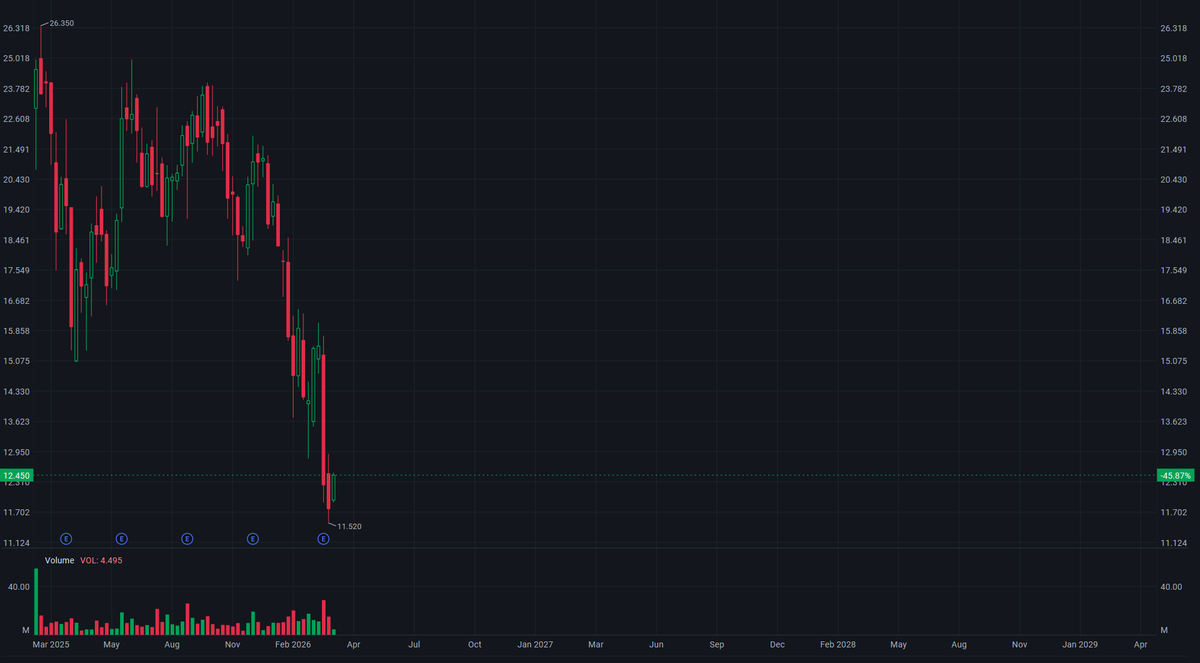
SailPoint’s capital trajectory presents a dramatic divergence. In 2022, private equity giant Thoma Bravo took the company private for $6.9 billion. As of March 2026, the newly re-listed SailPoint has a market capitalization of approximately $7 billion. After four years, the market cap remains nearly identical to its privatization price four years ago.
On the surface, this "treading water" in valuation masks a qualitative transformation in the company’s fundamentals:
- Performance Doubled: At the time of privatization, SailPoint’s annual revenue was approximately $500 million. The latest FY2026 report shows total annual revenue has reached $1.07 billion (24% YoY growth). Its Annual Recurring Revenue (ARR) has surged to $1.125 billion, up 28% YoY.
- Valuation Multiple (P/S) Halved: The $6.9 billion valuation in 2022 represented a Price-to-Sales (P/S) ratio of roughly 12x, which included a high private equity premium. The $7 billion valuation in 2026 corresponds to a P/S ratio of approximately 6.5x. Despite doubling its revenue scale and completing a full SaaS transition, the valuation multiple has nearly been cut in half, reflecting the extremely rational pricing currently applied to software companies in the public market.
- Financial Inflection Point: FY2026 marks a critical turning point. The company has officially turned Free Cash Flow (FCF) positive ($52 million for the year) and expects FCF to explode to $200 million in FY2027.
In short, today’s SailPoint is a segment leader that is twice the size and significantly more profitable, yet its "price tag" remains stuck at 2022 levels.
III. AI Agents: Booster or Disruptor?
The rise of AI Agents was once viewed as a threat to traditional governance logic. However, the reality of 2026 proves they have become a new engine for SailPoint’s growth.
- Explosion of Entities: AI Agents have created a massive influx of "new employees." In modern enterprises, the number of Non-Human Identities (NHI) has reached 45 times that of human identities. Every autonomous AI Agent requires a distinct identity and granular authorization. SailPoint’s Agent Governance Module addresses the risk of "privilege creep" caused by AI automatically requesting permissions or generating sub-agents. The more AI Agents there are, the deeper the enterprise dependency on SailPoint becomes.
- Autonomous Governance: Traditional privilege reviews relied heavily on manual labor. SailPoint now utilizes AI for Adaptive Governance. Based on intent analysis, the system can approve risk-free requests in real-time while intercepting anomalous Agent behavior. This evolution from "static auditing" to "real-time interception" significantly strengthens its competitive moat.
Potential Risks: Naturally, risks remain. If future AI-native platforms (such as large-scale cloud models) integrate perfect self-governance logic, or if emerging AI security startups leapfrog the industry using "pure semantic authorization" models, "add-on" platforms like SailPoint could face architectural obsolescence.
Summary
The emergence of AI Agents makes identity verification more complex and the demand for it more inelastic. Although SailPoint’s market cap has numerically returned to its starting point from four years ago, its internal logic has evolved from "relying on compliance" to "countering AI risks through technology"—risks that will only become more frequent.
To me, a company growing at nearly 25%, having just turned cash-flow positive, and holding the top spot in a core sector, is highly attractive precisely because its market cap appears to be "standing still."
Comment protéger la sécurité des données d'entreprise à l'heure où les agents IA sont déployés massivement ? Après tout, si un agent IA possède les droits de consultation et de modification des données critiques, les conséquences d'une erreur ou d'un piratage sont catastrophiques. La sécurité de l'identité (Identity Security) est passée d'un outil de conformité de back-office à la ligne de front absolue de la défense cybernétique. En tant que leader incontesté de ce domaine, le parcours de SailPoint a suscité mon intérêt.
Voici une synthèse de mes observations selon trois dimensions : la position sectorielle, la déconnexion profonde de la valeur boursière et l'impact des agents IA.
I. Position sectorielle : La "douane numérique" dominante
En 2026, SailPoint continue de dominer fermement le marché mondial de la Gouvernance et de l'Administration des Identités (IGA). Selon les dernières données de Gartner, SailPoint détient près de 21 % de part de marché, un chiffre environ cinq fois supérieur à celui de son concurrent direct le plus proche.
Sa compétitivité repose sur sa capacité à gérer la "complexité profonde". Contrairement à Okta, qui se concentre sur l'authentification de connexion, la plateforme d'identité unifiée Atlas de SailPoint gère les permissions structurelles de plus de 3 200 entreprises mondiales (dont plus de 50 % du Fortune 500). Aujourd'hui, elle gère non seulement les employés humains, mais contrôle également les identités numériques (API, comptes de service) dans des environnements multi-cloud, devenant ainsi le "cerveau central" de la gestion des privilèges.
II. Performance financière : Un chiffre d'affaires doublé pour une capitalisation stagnante
Le parcours boursier de SailPoint présente une divergence spectaculaire. En 2022, le géant du capital-investissement Thoma Bravo l'avait racheté pour 6,9 milliards de dollars. En mars 2026, après son retour en bourse, sa capitalisation boursière s'élève à environ 7 milliards de dollars. Après quatre ans, la valeur de l'entreprise est pratiquement identique à son prix de privatisation de 2022.
En surface, ce "surplace" boursier masque une transformation qualitative majeure :
- Performance doublée : Lors de sa privatisation, le chiffre d'affaires annuel de SailPoint n'était que d'environ 500 millions de dollars. Le rapport de l'exercice 2026 affiche un chiffre d'affaires total de 1,07 milliard de dollars (+24 % sur un an). Son Revenu Récurrent Annuel (ARR) a bondi à 1,125 milliard de dollars (+28 %).
- Multiple de valorisation (P/S) divisé par deux : En 2022, la valorisation de 6,9 milliards correspondait à un ratio cours/chiffre d'affaires (P/S) d'environ 12x. En 2026, la valorisation de 7 milliards correspond à un ratio P/S d'environ 6,5x. Malgré le doublement de sa taille et sa transition complète vers le modèle SaaS, le multiple de valorisation a presque été divisé par deux, reflétant la rationalité extrême du marché public actuel pour les logiciels.
- Inflexion financière : L'exercice 2026 marque un tournant. L'entreprise est officiellement devenue positive en flux de trésorerie disponible (Free Cash Flow) (52 millions de dollars) et prévoit une explosion de ce FCF à 200 millions de dollars pour l'exercice 2027.
En somme, SailPoint est aujourd'hui une entreprise deux fois plus grande et plus rentable, mais dont le "prix" reste figé au niveau d'il y a quatre ans.
III. Agents IA : Accélérateur ou perturbateur ?
L'émergence des agents IA était initialement perçue comme une menace pour la logique de gouvernance traditionnelle. Pourtant, en 2026, ils sont devenus le nouveau moteur de croissance de SailPoint.
- Explosion des entités à gérer : Les agents IA ont créé une masse d'identités non-humaines (Non-Human Identities - NHI), dont le nombre atteint désormais 45 fois celui des identités humaines. Chaque agent autonome nécessite une identité propre et des autorisations granulaires. Le module de gouvernance des agents de SailPoint répond précisément au risque de "dérive des privilèges" (privilege creep). Plus les agents IA sont nombreux, plus la dépendance à SailPoint s'accroît.
- Gouvernance autonome : Là où la révision des droits reposait sur l'humain, SailPoint utilise désormais l'IA pour une gouvernance adaptative. Le système analyse les intentions pour approuver en temps réel les accès sans risque et intercepter les comportements anormaux des agents. Cette évolution de l'audit statique vers l'interception en temps réel renforce considérablement ses barrières à l'entrée.
Risques potentiels : Bien sûr, des risques subsistent. Si les futures plateformes natives de l'IA intègrent leur propre logique de gouvernance parfaite, ou si des start-ups de sécurité IA utilisent un modèle d'"autorisation sémantique pure", les plateformes "externes" comme SailPoint pourraient voir leur architecture remise en question.
Synthèse
L'avènement des agents IA rend l'authentification plus complexe et son besoin plus impérieux. Bien que la capitalisation de SailPoint soit numériquement revenue à son point de départ, sa logique interne a évolué : elle ne vit plus seulement de la "conformité", mais de la "maîtrise technologique des risques IA". Pour moi, une entreprise qui croît de 25 % par an, qui devient rentable et qui domine son segment stratégique, est extrêmement attractive précisément parce que sa valeur boursière semble "faire du surplace".
如何在未来AI Agent密集运用的同时保护企业数据安全,毕竟ai agent如果拥有查阅修改核心企业数据的权限,那么当它出错或者被盗的时候,后果也是很严重的,**身份安全(Identity Security)**已从后台的合规工具演变为企业安全防御的最前线。作为该领域的绝对领导者,SailPoint 的历程引起了我的兴趣。
以下从行业地位、资本价值的深度背离、以及 AI Agent 带来的冲击三个维度进行我的发现总结。
一、 行业地位:统治级的“数字海关”
SailPoint 在 2026 年依然牢牢占据全球身份治理(IGA)市场的统治地位。根据 Gartner 的最新数据,SailPoint 拥有近 21% 的市场份额,这一数字大约是其最接近的直接竞争对手的 5 倍。
它的核心竞争力在于其处理“深层复杂性”的能力。不同于只负责登录验证的 Okta,SailPoint 的 Atlas 统一身份平台能够深入管理超过 3,200 家全球企业(包括 50% 以上的财富 500 强)的底层权限。目前,它不仅管理着人类员工,更通过其扩展模块统一管控跨多云环境下的 API、服务账号等数字身份,成为了企业内部权限流转的“中枢大脑”。
二、 经过了4年,市值和4年前被私有化的价格竟然差不多,而营业收入已经翻倍。
SailPoint 的资本路径呈现出一种极具戏剧性的背离现象。2022 年,私募巨头 Thoma Bravo 以 69 亿美元的价格将其私有化;而截至 2026 年 3 月,重新上市后的 SailPoint 最新市值约为 70 亿美元。经过了4年,市值和4年前被私有化的价格竟然差不多。
表面上,市值的“原地踏步”掩盖了公司内在质量的质变:
业绩翻倍: 私有化时,SailPoint 的年收入仅约 5 亿美元。而最新的 2026 财年报告显示,其年度总营收已达到 10.7 亿美元,同比增长达 24%;其年度经常性收入(ARR)更是飙升至 11.25 亿美元,同比增长 28%。
估值倍数(P/S)腰斩: 2022 年私有化时的 69 亿估值对应的是约 12 倍的市销率(P/S),包含了极高的私募溢价。而 2026 年的 70 亿市值对应的是约 6.5 倍的市销率。在营收规模翻倍、业务全面 SaaS 化的背景下,估值倍数却近乎腰斩,这反映了当前公开市场对软件公司定价已极度理性。
财务拐点: 2026 财年是 SailPoint 的关键转折点。公司已正式实现自由现金流转正(全年自由现金流为 5,200 万美元),并预计 2027 财年自由现金流将爆发式增长至 2 亿美元。
简而言之,现在的 SailPoint 是一家规模大了一倍、盈利能力更强、但“身价”却依然停留在四年前水平的网络安全细分领域龙头企业。
三、 AI Agent:是“助推器”还是“颠覆者”?
AI Agent(智能代理)的崛起,曾被视为对传统治理逻辑的威胁,但 2026 年的实战证明,它已成为 SailPoint 业务增长的新引擎。
在管理对象上,AI Agent 制造了海量的“新员工”。 现代企业中,非人身份(NHI)的数量已达到人类身份的 45 倍。每一个具有自主决策权的 AI Agent 都需要身份标识和精细授权。SailPoint 顺势推出的 Agent 治理模块,解决了 AI 自动申请权限、自动生成子代理带来的“权限膨胀”风险。只要 AI Agent 越多,企业对 SailPoint 的依赖就越深。
在管理手段上,AI 实现了治理的“自动驾驶”。 传统的权限复核极其依赖人工,而现在的 SailPoint 利用 AI 实现了自适应治理。系统能够基于意图分析,实时批准无风险的权限申请,并拦截异常的 Agent 行为。这种从“静态审计”到“实时拦截”的进化,极大提高了其产品壁垒。
当然,风险依然潜伏。如果未来的 AI 原生平台(如大型云模型)自带了完美的自我治理逻辑,或者新兴的 AI 安全初创公司利用“纯语义授权”模式弯道超车,SailPoint 这类外挂式平台将面临架构失效的考验。
总结
AI Agent的出现会让身份验证更加复杂和需求更加刚性。虽然Sailpoint市值在数字上回到了四年前的起点,但其内在逻辑已从“靠合规吃饭”进化为“靠技术抗衡 AI 风险”,而AI风险是未来越来越会频繁出现的。对于我而言,一家年增长近 25%、现金流刚刚转正、且在核心赛道市场占有率暂列第一的公司,其“原地踏步”的市值对我很有吸引力。
Risk Warning: This post is a result of personal study and does not constitute financial advice. I am currently in the process of learning translation, so there may be inaccuracies in the language used.
Position Disclosure: As of the time of publication, the author holds a position in this company. This is the reason I chose to research this topic. The author has no plans to trade this stock within the next 72 hours.